The awards honor individual cement facilities that exemplify the spirit of continuous environmental improvement and support this spirit with action. These plants went beyond government regulations and local laws to ensure that their processes and policies contributed to making their communities better places to live and work.
“The United States cement industry is dedicated to producing a superior product while challenging manufacturing policies and procedures to improve energy efficiency. The companies also recognize their role in making their local communities better places,” said Brian McCarthy, PCA president and CEO. “The actions taken by these plants and many others are at the fore-front of manufacturing technology and position the industry as a key contributor to the development of the latest energy expertise.”
Six categories recognized plants throughout the United States (listed by category, company and plant location):
- Overall Environmental Excellence: Lafarge North America Inc., Bath, Ontario
- Outreach: Holcim (US) Inc., Theodore, Ala.
- Environmental Performance: Lafarge North America Inc., Sugar Creek, Mo.
- Land Stewardship: CEMEX, Xenia, Ohio
- Innovation: Lafarge North America Inc., Tulsa, Okla.
- Energy Efficiency: CalPortland, Colton, Calif.
Twenty-six cement plants in the United States and Canada were nominated for the awards.
Overall Environmental Excellence
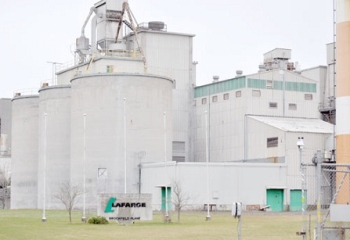
Lafarge North America Inc. – Bath, Ontario
In 2009, the Lafarge Bath plant completed a range
of environmental and energy efficiency projects. As part of its climate
change and energy efficiency programs, university researchers planted
hybridized willow species at the facility and other crops as possible
renewable biomass sources. The facility also worked with local farmers
to raise crops for a future trial biomass burn, and more than 950 bales
of plant material have been collected. The installation of new blower
technology allowed the plant to improve kiln operation and increase its
utilization of petroleum coke, an oil refinery byproduct. These actions
will reduce sulfur and carbon dioxide emissions and lower fuel
consumption. With additional kiln operation and quarry changes, the
facility has nearly eliminated cement kiln dust (CKD) production.
Likewise, the CKD monofills were improved because little to no CKD will
be produced in the future. Lastly with the help of 250 local scouts,
leaders, and parents, the facility planted 3,000 trees on the plant
property for habitat restoration and climate change education and
mitigation.
Outreach
Holcim (US) Inc. – Theodore, Ala.
The Holcim plant and its employees in Theodore
support a range of environmental projects in their community. In 2009,
plant employees were zone captains for cleanup of the Theodore
Industrial Canal as part of the 22nd annual Alabama Coastal Cleanup Day
sponsored by the Alabama Department of Conservation and Natural
Resources. Seventy-one plant and community volunteers removed more than
1.5 tons of debris from the banks and waters of the Canal. The plant
also worked with the Alabama Coastal Foundation in the evaluation of
the shoreline of the Fowl River and continues to assist with the local
Used Electronics Recycling Days. Nearly 200,000 pounds of unwanted
electronic devices were collected in 2009.
Environmental Performance Award
Lafarge North America Inc. – Sugar Creek, Mo.
The Lafarge Sugar Creek facility completed a range
of projects in 2009 to increase the amount of alternative raw materials
and fuels used by the plant while continuing to keep emissions
significantly below permit limits. By connecting to a third source in
2009, landfill gas replaced 17 percent of the plant’s fossil fuels,
which would offset more than 30,000 tons of carbon dioxide from coal
combustion. Modifications to its alternative solid fuels facility
allowed the Sugar Creek plant to double the percent of fossil fuel
replacement—to 20 percent. In 2009, the facility utilized limestone
fines from an adjacent quarry to replace more than 14 percent of the
limestone needs of the kiln. The plant also substitutes 35.8 percent of
its non-limestone raw materials with a range of non-hazardous
industrial wastes such as bottom ash, boiler slag, foundry sands, and
mill scale.
Land Stewardship
CEMEX – Xenia, Ohio
The CEMEX Xenia facility has approached its land
stewardship tasks as a cooperative effort with the community,
Cedarville University, and the United States Fish and Wildlife Service.
In 2009, the plant and its partners began the first phase of the
eradication of a 4.5-acre kudzu infestation, a non-native, invasive
vine. After careful evaluation, a plant-specific, systemic herbicide was
selected and targeted application completed. The eradication will help
to return the area to native vegetation and to educate the local
community on kudzu control and elimination. Another project with
university student assistance is the monitoring of a 47-acre native
grassland habitat at a former clay mine that will foster nesting
habitat for grassland birds. The reclamation plan is based on United
States Fish and Wildlife Service and Audubon Society guidelines which
exceed mining regulations.
Innovation
Lafarge North America Inc. – Tulsa, Okla.
In 2009 the Tulsa Lafarge plant took advantage of
an alternative fuel opportunity that builds upon a waste stream the
industry has been using for years. Most tire-derived fuel use is based
on used tires, but the Tulsa plant worked with Goodyear, Inc., to
divert rubber manufacturing waste from landfills and into the cement
kiln. The plant accepts bagged scrap rubber and malformed rubber
components which are delivered to a mid-kiln injection system by way of
a high angle conveyor. In addition, the plant utilizes 100 percent
Biogas from a nearby landfill for the drying of raw materials and up to
a 20 percent substitution of the kiln fuel needs.
Energy Efficiency
CalPortland – Colton, Calif.
The CalPortland plant in Colton completed several
unique energy reduction projects in 2009. The facility has a
comprehensive intranet site that displays energy performance
information in dollars, energy units, and specific energy. Several new
installation upgrades lead to tremendous energy savings. New high
efficiency separator, baghouse, and material handling equipment will
save nearly 7 million kWh annually for finish cement grinding; the
completion of a kiln air leak reduction program will save more 5.7
million kWh; and the installation of a new cement terminal is expected
to save more than 3.7 million kWh. These and other initiatives resulted
in the plant scoring a perfect 100 through ENERGY STAR’s EPI
benchmarking tool. In addition, Colton has also established national
accounts with suppliers which include energy efficiency as part of
their contracts.
History of the Awards
The awards program was created in 2000 by the
Portland Cement Association as part of its renewed environment and
energy strategic plan for the U.S. cement industry. The awards honor
activities conducted during the previous calendar year, and the program
is open to any cement manufacturing plant in North America. Judges for
the 2010 awards represent independent groups such as National Ready
Mixed Concrete Association, U.S. EPA-ENERGY STAR, U.S. EPA-Office of
Policy, Economics and Innovation, Cement Association of Canada, Cement Americas, U.S. Geological Survey, World Resources Institute and World Wildlife Fund.
About PCA
Based in Skokie, Ill., the Portland Cement
Association represents cement companies in the United States and
Canada. It conducts market development, engineering, research,
education, and public affairs programs. More information on PCA
programs is available at www.cement.org.
Anh Vân- Theo www.cement.org